NW180: Developing Scent-sational Skills for Competition
Course Details
You’ve learned the basics, even dabbled in some advanced skills but are you ready for competition? With so many scent detection organizations out there now (up to 11 and counting!) teams are entering competition faster than ever and moving up even faster! This class will help you be prepared and even assess IF you should be trialing yet. As we all know, a rocky foundation will not support the higher levels of any sport! The challenges and skills required at the higher levels of scent detection sports are FUN and interesting. You want to soar when you get to those levels and have the foundation to support it. Learn now what you’ll need later!
This course will cover the importance of handling and observing our scenting dogs. We’ll learn how we can support them and also to allow them to be independent. We will spend more time on newly learned elements (vehicles, buried, exteriors) and continue to strengthen our container and interior skills. We will also cover trial time strategies - and what to do with the unexpected happens, or what you can expect and make a plan for! What do you do if your dog goes back to a found hide or is distracted? We’ll cover that here! Handler focused dogs? We’ll cover that too!
This is the perfect class to perfect your foundation and element skills before diving into more complex and advanced skills.
Prereq: Dogs should be on at least 2 odors, and have equivalent of skills covered in NW120 - Introduction to search elements.
Teaching Approach
This class offers written lectures, no verbal lectures, and videos of varying length. Lectures are designed to be watched and follow the ideas presented in the lecture. Lecture videos may run from 1 to 4 minutes long, with the average between 1-2 minutes. The lectures are designed to help a student understand the purpose of the exercise and how it might vary by dog. Each week, lectures are usually rolled out in 2 batches - the night before each week and a few days into each week. This class will work best for students who learn by reading text lectures, watching videos and who like having structured lesson plans.
This class will have a Teacher's Assistant (TA) available in the Facebook study group to help the bronze and silver students! Directions for joining that Facebook group will be in the classroom after you register.
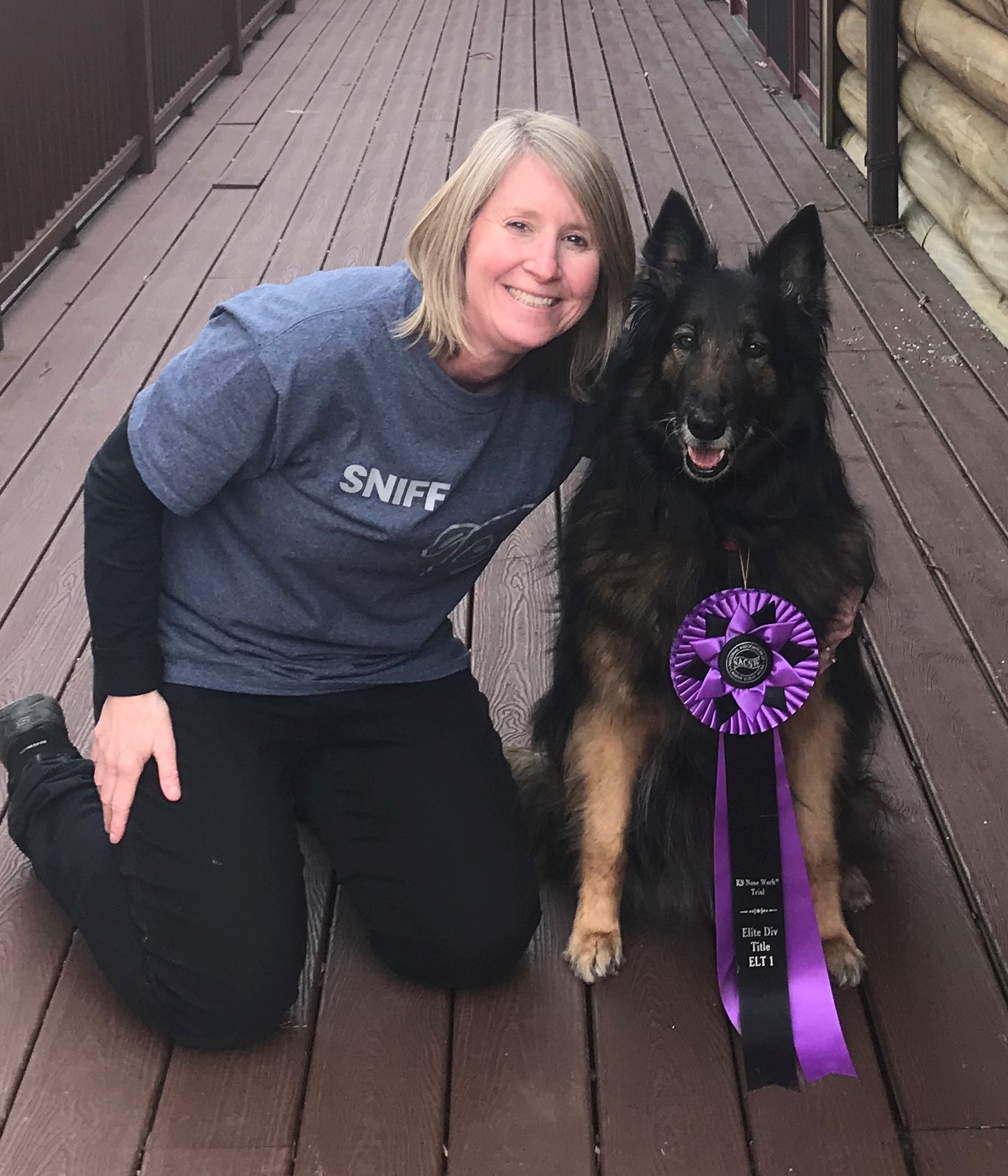
Julie Symons (she/her) has been involved in dog sports for over 30 years. Starting with her mix, Dreyfus, in flyball, she went on to train and compete in conformation, agility, obedience, herding and tracking with her first Belgian tervuren, Rival. Rival was the first CH OTCH MACH Belgian...(Click here for full bio and to view Julie's upcoming courses)
Prereq: Dogs should be on at least 2 odors, and have equivalent of skills covered in NW120 - Introduction to search elements.
Supplies: Odor kit and scent vessels. Access to vehicles, interior spaces and exterior areas. Containers of any kind - boxes and plastic shoe box containers are the most common.
Containers can really be CRAZY and they tend to have the lowest pass rate across the board. So many configurations and strategies to decide. Of course containers have that added complexity of housing distractors, but we won’t focus on that right now. Let’s toss that aside and focus on just the sheer complexity that there can be with containers.
Before we jump into the various container configurations, I like to train blank searches early in our dogs career so that they don't always expect to find odor. Both my older dogs have had a tendency to false on the last box of a line when they hadn't found odor yet. This training and setup will help our dogs feel confident if they don't find odor right away and to only indicate when there clearly is odor.
A useful handling tip is to assume every search area is blank until your dog shows you otherwise. That's much better than trying to get your dog to source something that isn't there.
Simple Blank Container Search
First, let’s run a blank container search! Yep, a blank. It’s not scary at all. It’s quick and allows us to rehearse methodical searching without odor in the picture. It won't demotivate your dog to not find odor. After you leave the boxes, say "Finish" and you can reward you dog with food, toy or personal play. If you are feeling uncomfortable to reward your dog for not finding odor, you can ask for a trick and then reward. I personally have no issue rewarding a blank area search since scent detection is not just about finding odor, but also clearing blank areas. In NACSW NW3 their MAY be a blank search in ANY of the elements (when it used to only be for interiors). I would ALSO make sure not to say "Finish" when your dog is on the last cold box in a row - wait for them to dismiss the boxes void of odor.
KEY POINTS:
Run one blank, then followed right away with odor.
Get in and get out on the blank. Don't worry about checiing each box. Call finish when they disengage from the boxes.
Future blank setups should be in a NEW area with no trace of odor from previous searches.
Steps:
Prepare a hot box and let it age for at least 20 minutes. Using a well vented container would be ideal.
Set up short line of containers - all cold - in a single line. I used 5 containers.
Set up a start line/pylons.
Run your dog on leash. This is the BLANK search.
Take your dog down the line. If they walk off the last box, great, say "finish" and reward away from the boxes. If your dog wants to turn back and go back down the line, that is fine too then finish off the end of the 2nd pass. Make sure NOT to use your marker word, but to say "Finish" and reward, which is what you will say in a trial that may have a blank search. Calling "Finish" means you have cleared the area and found all or none of the hides present.
Put your dog up or in a down and place a hot container in the row. You can replace one that is there or add another box. Place it somewhere in the middle and NOT at the end. We don't want to reinforce the last box with being hot in this situation.
Run your dog on leash. This is a search with ONE hot container.
Here is Moxie doing this for the first time. Here is a 3 pass on blanks. I had good timing on the "Finish". On her other ones when I tried to not have her pass 2 or 3 times I influenced too much with pulling her off. So play around to find your dogs understanding that it's clear - without waiting too long to false!
Extra Credit
Here is a variation of the Blank exercise - setting it up more as a drill and not a formal search.
Outcome (what is the goal of the session)
For the dog: Dogs must learn to recognize blank areas and not "find" something that isn’t there. They also need to dismiss novel odors in both productive and unproductive areas, while quickly locating target odor in the presence of competing motivators (distractors).
For the handler: Be neutral and call Finish on blank areas when dog dismisses the set of containers. Don’t wait or expect them to check all of them. Capture the moment they disengage from the containers, even if they only check a few and leave - call Finish. “Finish” becomes a marker and should be rewarded.
Setup:
Place 5-6 sturdy containers spread out in a “pile” on the ground.
Sit on the ground or in a chair.
Steps:
Rep 1: All containers are blank. Cue search, and call Finish when your dog dismisses the pile. Reward the finish call.
Rep 2: All containers are blank, except one has a distractor inside a cold container. There is NO target odor. Cue search, and call Finish when your dog dismisses the pile. Reward the finish call. One way to add a distractor that is NOT in a container is to use an small empty bag of chips. Know your dog!
Rep 3: Place one target odor out in a hot container. Odor should be very accessible - not contained (inside switch box, ceramic mug, shoe, etc). There are no distractors. Cue search, mark and reward as you do normally.
Rep 4: All containers are blank - suggest move to a slightly new area to avoid lingering odor - and add a toy distractor. The toy distractor can be inside a vented container to start. Work up to having the toy on the ground where they will dismiss it.
Rep 5: Add target odor with a toy distractor.
Video example:
Troubleshooting
If the dog falses or is guessing on the blank setups:
I will pick it up and admire it and then put it back down.
Stand up if your position on the ground is causing handler focus.
A common mistake is to stay in too long - call Finish anytime your dog is wanting to leave the pile of containers. Don’t require them to check all of them.
A sampling of what prior students have said about this course...
Awesome new class! Lectures were interesting and had lots of great exercises, and Julie's comments were super helpful. We had a lot of fun and learned a lot!
Enjoyed this class very much. Julie gave thoughtful and useful feedback and the lessons will be helpful to fall back on when needed.
Loved the course, learnt a lot and it was easy to understand and execute. Will definitely advise anyone that is interested in this sport to get on this course.
Best instructor ever! Great problem solver.
This was the perfect class to follow NW120! Kudos to Julie for putting together such a great class to help dogs and handlers strengthen fundamentals prior to trialing and prior to working on more advanced nosework skills.
Julie is awesome!!! Did this class at gold, this is my third Nosework dog and it was the perfect class for the pup and I.
Julie really stands out even among other FDSA instructors for how much she cares about the people in her class -- her empathy and caring for all parts of the human/dog team really shone through even in the online format.
Registration
There are no scheduled sessions for this class at this time. We update our schedule frequently, so please
subscribe to our mailing list for notifications.
Registration opens at 12:00noon Pacific Time.
SILVER LEVEL Update - Students will be permitted to submit ONE 90 second video each week. For additional details on all enrollment levels please view our Getting Started section on our Help Page.
 Instructor: Julie Symons


